

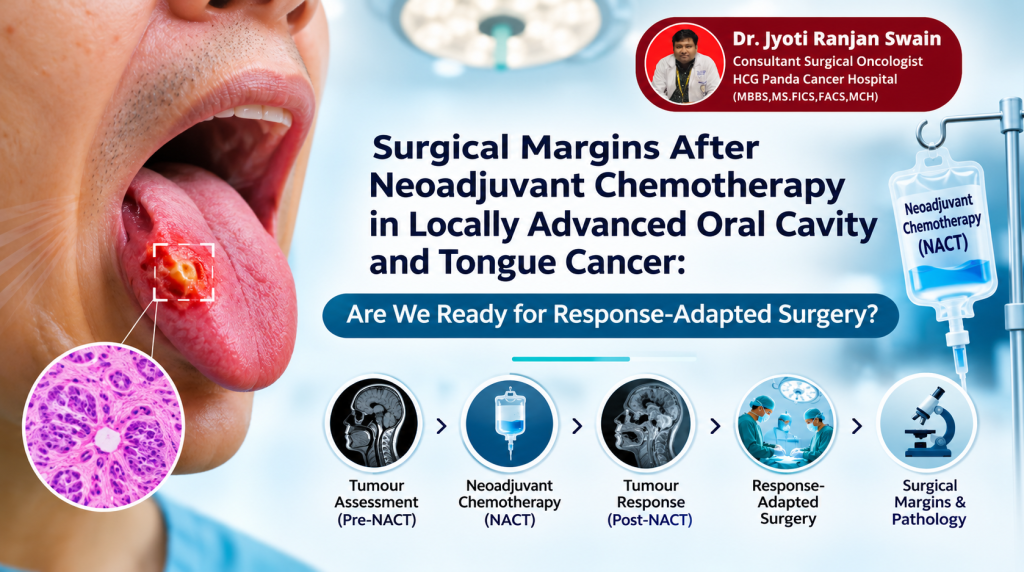
Balancing Oncological Safety, Margin Clearance and Functional Preservation in the Era of Neoadjuvant Chemotherapy.
This title is suitable for a medical journal article, surgical oncology review, conference presentation, or academic discussion.
Traditionally, a pathological clearance of more than 5 mm is considered adequate, 1–5 mm is classified as close, and tumour at the inked margin is considered positive. However, these conventional definitions have not been adequately validated in post-NACT specimens.
Unlike concentric tumour shrinkage, chemotherapy-induced regression is often heterogeneous. Extensive fibrosis, necrosis and scattered islands of viable tumour may persist within the original tumour bed. Consequently, radiological response does not necessarily reflect microscopic tumour clearance. A substantial reduction in tumour volume on MRI should therefore not automatically justify a proportionately smaller resection.
Evidence from studies comparing NACT with upfront surgery suggests that induction chemotherapy can reduce positive surgical margins in selected patients. However, this improvement has not consistently translated into a survival advantage. More importantly, contemporary retrospective evidence indicates that positive surgical margins remain strongly associated with inferior local control and survival even after NACT.
An important controversy concerns the significance of close but negative margins. Studies in untreated oral tongue cancer suggest that margins below 2–2.2 mm may carry greater recurrence risk, challenging the traditional 5-mm threshold. Nevertheless, these findings cannot be directly extrapolated to post-NACT patients, for whom no universally accepted margin-distance standard exists.
The emerging concept of response-adapted surgery offers an opportunity to preserve function without compromising oncological clearance. However, surgical planning should integrate pretreatment tumour extent, post-treatment imaging, residual disease distribution and anatomical boundaries rather than relying exclusively on the residual radiological abnormality.
Meticulous specimen orientation, en-bloc resection and extensive pathological sampling are particularly important. Pathologists should document tumour-bed dimensions, percentage of viable tumour, distribution of residual disease and distance from the nearest inked margin.
Management of close or positive margins should be individualised. Further resection should be considered whenever feasible for involved margins. Postoperative radiotherapy or chemoradiotherapy should be guided by final pathological findings, including margin status, extranodal extension, nodal burden and other adverse features.
The way forward: NACT should change our surgical strategy, but not compromise our oncological principles. Response-adapted surgery is promising, particularly for functionally critical structures such as the tongue. Until prospective evidence establishes the safety of reduced margins, the ultimate objective must remain an anatomically sound R0 resection, guided by both the original tumour footprint and residual disease distribution.
The goal of modern surgical oncology is not simply to remove less tissue, but to preserve maximum function while maintaining uncompromised oncological safety
